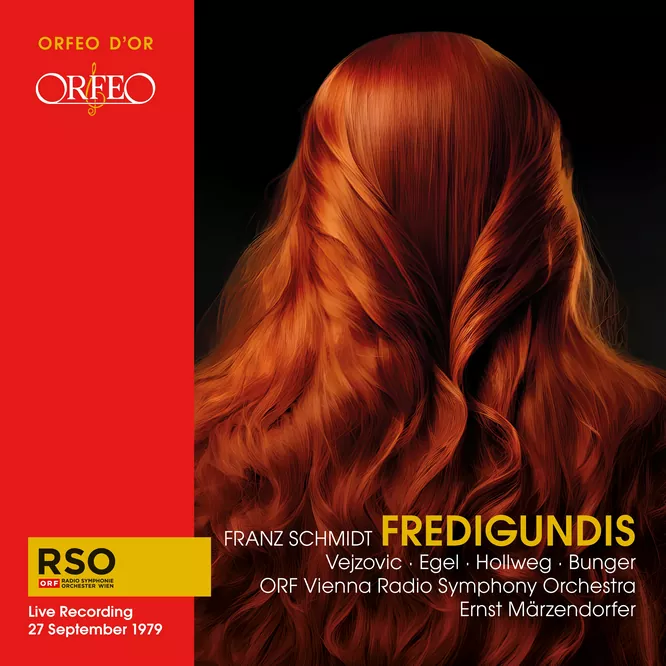
| 01. Act I_ Overture 02. Act I_ Fredigundis! Fredigundis! 03. Act I_ Meinst du, ich s?h es nicht 04. Act I_ N?rrchen du! 05. Act I_ Landerich! Ein Schiff, ein goldenes Schiff! 06. Act I_ Der K?nig hat mich angesehn! 07. Act I_ Landerich! Was thust du hier 08. Act I_ Versto?en! Fortgetrieben! 09. Act I_ Das nenn’ ich wahrlich Jagdglück haben! 10. Act I_ O K?nig! Starker Helde! Sei mir willkommen! 11. Act I_ Steh’ auf, Rotliebchen! 12. Act I_ Es brennen die Sinne! 13. Act II_ Sie schl?ft! Ringsum kein Laut! 14. Act II_ Wir sind zur Stelle. La? mich jetzt allein! 15. Act II_ Wer ruft_ Ehrwürden! Gro?er Gott! 16. Act II_ Mord, schrei’n sie! Wehe! 17. Act II_ Heil dem K?nig! 18. Act II_ Rosen, rote Rosen streuen ihren Pfad! 19. Act II_ Markgrafen! Grafen meines Reichs! 20. Act II_ Mein K?nig! Chilperich! 21. Act III_ Prelude 22. Act III_ Gott hat mich schwer gestraft 23. Act III_ Mich rief die K?nigin, was ist ihr Wunsch_ 24. Act III_ Landerich! O h?re mich! 25. Act III_ Mein Kindlein, sei getrost! 26. Act III_ O Herrin! K?nigin! Das Kind! Ihm ist nicht wohl! 27. Act III_ Was soll der Schwur_ 28. Act III_ K?nigin, das Kind ist tot! 29. Act III_ Interlude 30. Act III_ Zum letzten mal komm’ ich zu dir, mein K?nig 31. Act III_ Zur Stelle bin ich, ge?ffnet ist der Sarg 32. Act III_ Ich sehne mich nach deines Mundes Glut 33. Act III_ Mein K?nig, bist noch nicht wach_ 34. Act III_ Chilperich, mein Gemahl, o h?re! 35. Act III_ Das Zeichen, es kam mir nicht von euch In 1914, Franz Schmidt staged his opera Notre Dame at the Vienna State Opera to great acclaim. Immediately afterwards, he was looking for new material for another project and came across the novel Fredigundis by Felix Dahn, which is loosely based on historical events from the 6th century. From 1916 to 1921, Schmidt worked on his project, which was premiered in Berlin in December 1922. Franz Schmidt’s music for Fredigundis marks the end of a development that runs through the so-called “classic Romantic” period. The work is characterized by numerous chromaticisms and an expansion of the major-minor system in the music that pushes the boundaries of tonality, as well as dense counterpoint and perfect compositional artistry in the vocal parts. The dramatic mezzo-soprano Dunja Vejzovic, who got famous for her Wagner roles in Bayreuth and Salzburg, performed on all major opera and concert stages of the world. The excellent set of singers in this performance is supported by the Austrian conductor Ernst Märzendorfer, who mastered several instruments and also composed piano concertos, incidental music and a ballet. On this recording, he conducts the ORF Vienna Radio Symphony Orchestra, which has established itself as an opera orchestra through its continuously successful collaboration with the MusikTheater an der Wien. |