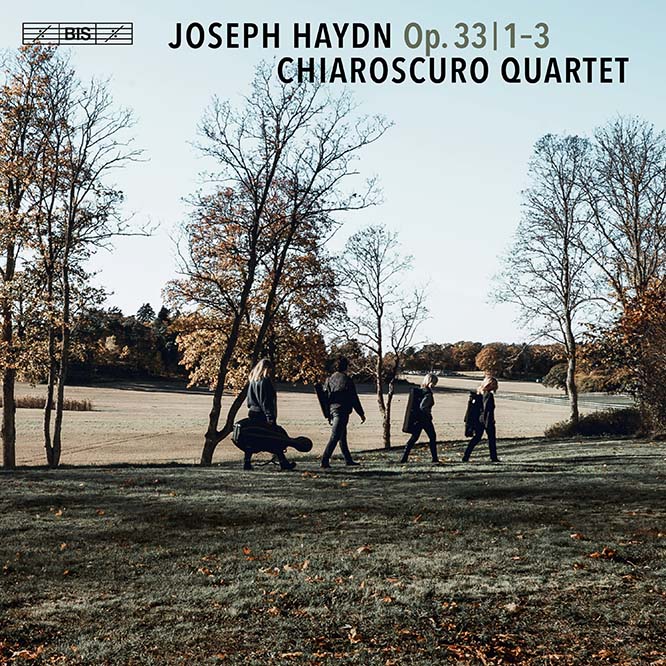
| “Gut strings and classical bows are also the tools of a captivating quest for sonority”, French magazine Diapason recently wrote to describe the Chiaroscuro Quartet. After Op. 20, Joseph Haydn’s first major string quartet cycle, and Op. 76, his last, the internationally renowned ensemble is now embarking on the Quartets Op. 33, dubbed the “Russian Quartets” and dedicated to the Russian Grand Duke Paul, the future Tsar Paul I.
Having earned a reputation as eccentric and non-conformist, sometimes downright offensive, Haydn felt the need to write music more in keeping with the public’s lighter, more ‘popular’, less ‘scholarly’ tone, with a livelier sense of rhythm. And while there is comedy in some of the scherzos, it would be wrong to reduce these works to what some dour critics have called ‘comic fooling’. In Quartet No 1 in B minor, the comedy is cerebral, often disturbing. This is certainly not the case in Quartet No 2 in E flat major, nicknamed “The Joke” because of the sparkling tarantella that concludes it. In Quartet No 3 in C major, “The Bird”, Haydn invites us to a veritable bird concert before concluding brilliantly with its persistent refrain inspired by a wild Slavic folk dance. Joseph Haydn String Quartet in E flat major (The Joke), Hob. III:38, Op.33 No. 2 18”06 String Quartet in C major (The Bird), Hob. III:39, Op.33 No. 3 19”58 |
声明:本站所有hires无损音乐均转载于互联网,并不代表本站立场!如若本站内容侵犯了原著者的合法权益,可联系我们进行处理! 拒绝任何人以任何形式在本站发表与中华人民共和国法律相抵触的言论!