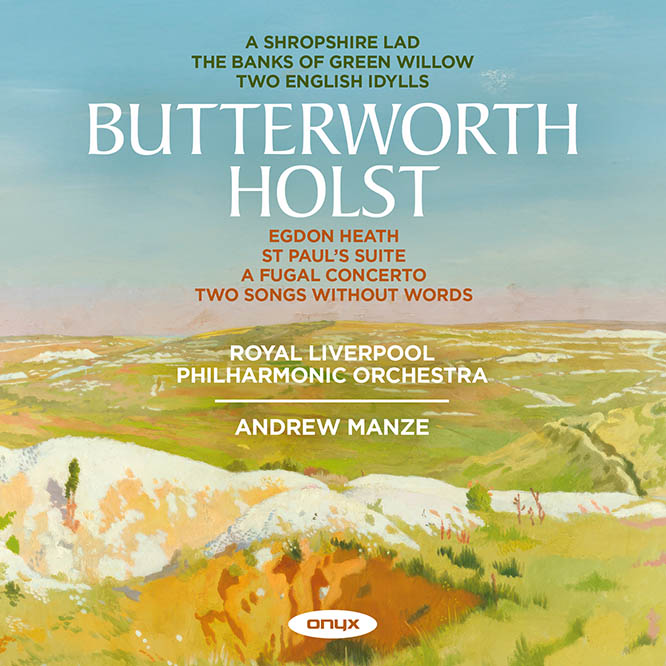
| George Butterworth, one of the pre 1914 generation lost in the Great War, left a small but enduring body of work. He was introduced to folk music by Vaughan Williams, but he was also a dancer and collector of folk songs and dances – especially those from Sussex. It is however his A.E Houseman inspired orchestral rhapsody, A Shropshire Lad, that has become his most famous composition and seems to conjure up a powerful sense of the countryside of that county, and melancholy at the waste and futility of war. Holst, like Butterworth was a friend of Vaughan Williams, and together the two of them collected folk songs from around England. Holst also taught at the school for girls in Hammersmith, London and the St Paul Suite is a personal thank you to the school. Folk songs imbue the two Songs without Words. Holst became friendly with Thomas Hardy, and it was on a night walk (at the urging of Hardy) that the inspiration for Egdon Heath came to Holst. The 15-minute-long work capture the ‘singularly colossal and mysterious in it’s swarthy monotony’ as Hardy described the area of moorland in his novel The Return of the Native. The high trumpet at the close of the work is surely sounding from post war sad shires.
01 A Shropshire Lad _Rhapsody for Full Orchestra_ |
声明:本站所有hires无损音乐均转载于互联网,并不代表本站立场!如若本站内容侵犯了原著者的合法权益,可联系我们进行处理! 拒绝任何人以任何形式在本站发表与中华人民共和国法律相抵触的言论!