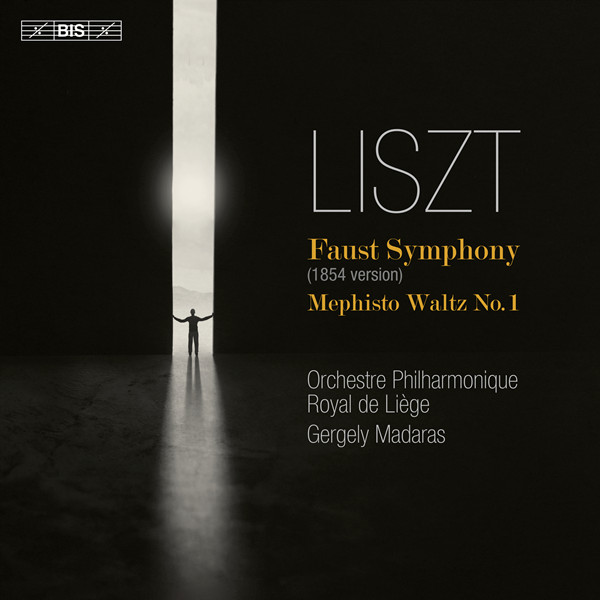
| Few literary works exerted as strong an influence on European culture in the 19th century as Goethe’s play Faust. While several important composers drew inspiration from it, Franz Liszt seems to have had a particularly close relationship with Goethe’s masterpiece. He came up with the idea of a symphony ‘in three characteristic pictures’, each devoted to a key character in the play: Faust, Gretchen and Mephistopheles. Rather than telling the story of the play, Liszt composed a psychological exploration of these three main figures. He was also a pioneer in his use of leitmotifs, i.e. short musical ideas that underline a trait of character or evoke feelings, a process that his future son-in-law, Richard Wagner, would take even further in his operas.
The Orchestre Philharmonique Royal de Liège, led by Gergely Madaras, presents the original, purely instrumental version of the Faust Symphony from 1854. This gigantic work is complemented by the first of the Mephisto Waltzes, inspired by Nikolaus Lenau’s vision of the Faust myth. These two works offer two very different perspectives on Liszt’s intense relationship with the character of Faust, and in particular with that of Mephistopheles, around whom many of his compositions are structured. They are key works for understanding Liszt’s aesthetic project and the typical nineteenth-century tendency towards a combination of the arts. 01. Orchestre Philharmonique Royal de Liège – Faust Symphonie, S 108 (1854 version) I. Erster Teil. |
声明:本站所有hires无损音乐均转载于互联网,并不代表本站立场!如若本站内容侵犯了原著者的合法权益,可联系我们进行处理! 拒绝任何人以任何形式在本站发表与中华人民共和国法律相抵触的言论!