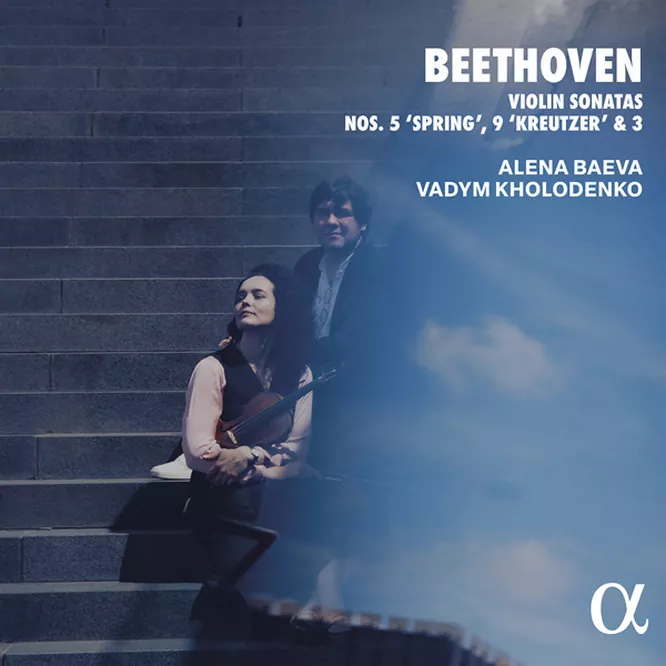
| 01. Alena Baeva – Violin Sonata No. 5 in F Major, Op. 24 Spring I. Allegro 02. Alena Baeva – Violin Sonata No. 5 in F Major, Op. 24 Spring II. Adagio molto espressivo 03. Alena Baeva – Violin Sonata No. 5 in F Major, Op. 24 Spring III. Scherzo. Allegro molto 04. Alena Baeva – Violin Sonata No. 5 in F Major, Op. 24 Spring IV. Rondo. Allegro ma non t 05. Alena Baeva – Violin Sonata No. 9 in A Major, Op. 47 Kreutzer I. Adagio sostenuto – Pre 06. Alena Baeva – Violin Sonata No. 9 in A Major, Op. 47 Kreutzer II. Andante con variazion 07. Alena Baeva – Violin Sonata No. 9 in A Major, Op. 47 Kreutzer III. Finale. Presto 08. Alena Baeva – Violin Sonata No. 3 in E-Flat Major, Op. 12 No. 3 I. Allegro con spirito 09. Alena Baeva – Violin Sonata No. 3 in E-Flat Major, Op. 12 No. 3 II. Adagio con molt’ es 10. Alena Baeva – Violin Sonata No. 3 in E-Flat Major, Op. 12 No. 3 III. Rondo. Allegro mol Beethoven: Violin Sonatas Nos. 5 ‘Spring’, 9 ‘Kreutzer’ & 3 brings together three of Ludwig van Beethoven’s most significant violin sonatas: the Sonata No. 3 in E-flat major, Op. 12 No. 3; the Sonata No. 5 in F major, Op. 24, known as the “Spring”; and the monumental Sonata No. 9 in A major, Op. 47, the “Kreutzer.” Performed by violinist Alena Baeva and pianist Vadym Kholodenko, the program spans the crucial years between 1797 and 1803 — a period marking both Beethoven’s growing international recognition and the first signs of his encroaching deafness. Op. 12 No. 3 still reflects Classical elegance, yet already reveals Beethoven’s bold handling of dialogue between violin and piano. With the “Spring” Sonata, Op. 24, lyricism unfolds with radiant warmth, its expansive first movement and expressive Adagio shaping a work of luminous balance and charm. The “Kreutzer” Sonata, Op. 47, stands at the threshold of Beethoven’s heroic style. Dramatic contrasts, structural daring and virtuosic intensity redefine the genre, transforming the violin sonata into a symphonic-scale confrontation between equals. The Adagio sostenuto introduction gives way to a fiery Presto, while the variation movement and final Presto project both theatrical tension and explosive energy. Drawing on historical awareness of early nineteenth-century performance practice — including flexibility in ornamentation and phrasing — Baeva and Kholodenko explore the polarity between textual fidelity and interpretative freedom. Their approach embraces Beethoven’s openness while respecting the structural integrity of the score. Recorded in December 2024 at the Kulturzentrum Gustav Mahler in Toblach, Italy, this album captures a partnership of exceptional intensity and refinement, illuminating Beethoven’s evolving language at a pivotal creative moment. |