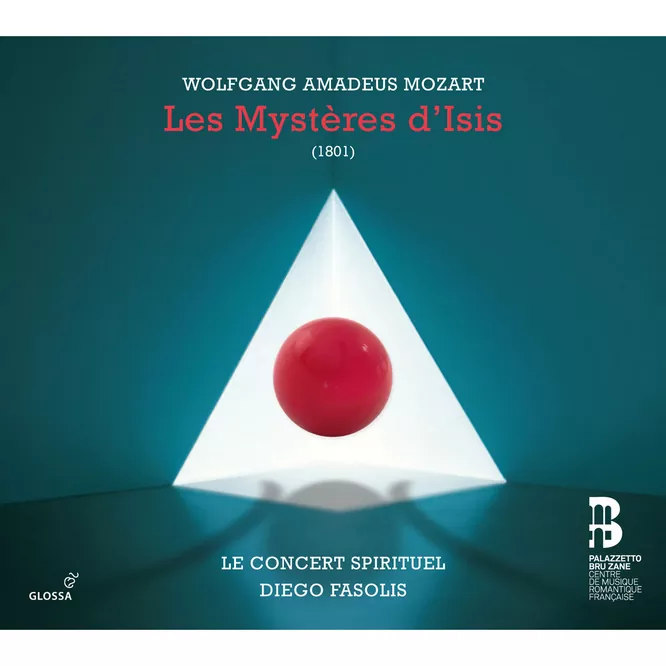
| 01. Overture 02. Dans ce fortuné séjour 03. ? Déesse immortelle 04. Dès que l’astre du jour 05. Isis, dissipe le nuage 06. à la main d’Isménor 07. Cérémonie religieuse 08. Moteur de l’univers 09. Rentrons, je vois Isménor 10. De feux cruels 11. Quel sort affreux! 12. Où suis-je _ 13. ? gage si cher 14. Isis, qui du ciel 15. Sous les yeux 16. Me voilà seul 17. ? ciel, quelle injustice! 18. Quels que soient 19. Vers nous elle adresse 20. Punis un coupable 21. N’en doutez pas 22. On peut compter 23. Vous voilà donc 24. Dans les bras 25. J’entends du bruit 26. Plus de tristesse 27. Mais dis-moi donc 28. Je vais revoir 29. Si nos gardiens venaient 30. Si la vertu t’inspire 31. Espoir divin 32. Parle, jeune étranger 33. Non, loi dure 34. Je vais vous encha?ner 35. Quel charme 36. De Zarastro célébrons 37. à vos yeux 38. Ne vous montrez 39. Cédez à sa puissance 40. Fuyez, c?urs faibles 41. J’ai d? vous prévenir 42. Trop coupable Isménor 43. Quel charme 44. Venez, comme un dieu 45. Entrée des prêtres 46. Des volontés d’Isis 47. Dans ce séjour tranquille 48. Et vous, dont le soin 49. ? nuit sombre 50. Pour obtenir une vie éternelle 51. Tout comme lui 52. Champs des larmes 53. Venez, le ciel l’ordonne 54. Où suis-je_ 55. La vie est un voyage 56. Je frémis 57. Dieu d’amour 58. Je vous suivrai 59. Cette femme m’abuse 60. Je vais quitter la vie 61. Il faut lutter 62. épreuve de l’eau 63. épreuve du feu 64. Victoire! 65. Avan?ons-nous 66. En croirais-je mes yeux_ 67. Qu’hymen s’empresse You may be shocked to see Mozart’s name attached to an 1801 date on this Glossa release, but the actual nature of the recording is not so shocking: Les Mystères d’Isis is an adaptation of Die Zauberflöte, K. 620 (The Magic Flute), made for the Paris Opera by the Bohemian composer Ludwig Wenzel Lachnith and the French librettist Etienne Morel de Chédeville. This is no mere translation. Not only Chédeville, but also Lachnith, remade Mozart’s opera to suit French tastes and even French singers, lowering the Queen of the Night, for example, to a mezzo-soprano. The two acts of the original opera become four, with interpolated arias from other Mozart operas (including Don Giovanni) and even the slow movement of Haydn’s Symphony No. 103 in E flat major, H. 1/103 thrown in as a curtain raiser. Certainly such insertion arias were common at the time, but the degree of alteration here is extreme. All the characters’ names change except for Pamina’s and Sarastro’s, and Papageno becomes a much more significant figure. The question arises as to why the French would have been interested in the opera at all in a form shorn of its original content; the detailed booklet points out that the opera’s Egyptian setting would have contributed to its appeal, and notes further that even Wagner’s operas were performed in French at their premieres. The whole project is interesting for the insight it provides into a time when classical compositions were something other than the sacred texts they later became. Berlioz, who helped that process along, savaged Les Mystères d’Isis mercilessly (the terms “wretched hodgepodge” and even “assassination” were used), as did Mozart’s biographer Otto Jahn, who noted correctly that the adaption strips the low comedy out of the opera. It is nevertheless indefinably appealing to hear this familiar music sung in French, and instructive to study this chapter in the history of how the Mozart legend took shape. The performances are fine: Renata Pokupic as the Queen of the Night, here named Myrrène, is a standout, and the historical instruments of the group Le Concert Spirituel under Diego Fasolis realize unusual and even lush orchestral textures that might not have been recognizable to Mozart but are part of his reception history. Those interested in that reception history will be intrigued by this release. |